
Key takeaways
Before filing taxes online, gather your forms and documents, including W-2s and 1099s.
File your taxes online on or before the due date, which is April 15, 2026.
Choose between the standard deduction and itemized deductions, and gather any receipts or other documents if you choose the latter.
Don't forget to claim any tax credits and deductions you're eligible for to maximize your tax refund.
The deadline to file 2025 taxes is April 15, 2026. (see disclosure 1) There's no time like the present to get organized and make some decisions regarding your 2025 taxes. This way, you can avoid filing your taxes online at the last minute.
Learn how to file taxes online quickly and easily and take the headache out of tax season.
How to do taxes: Best tips
Taxes are no one's idea of fun. A Chime survey about financial literacy found that 25% of respondents would rather do homework than file taxes, while others would rather dissect a frog or take a calculus exam.
It's no secret that filing taxes may be something you're putting off or not looking forward to. But filing your taxes late can get you in hot water with the IRS. These tips will prepare you to file your taxes on time and accurately.
Gather your tax forms and documents
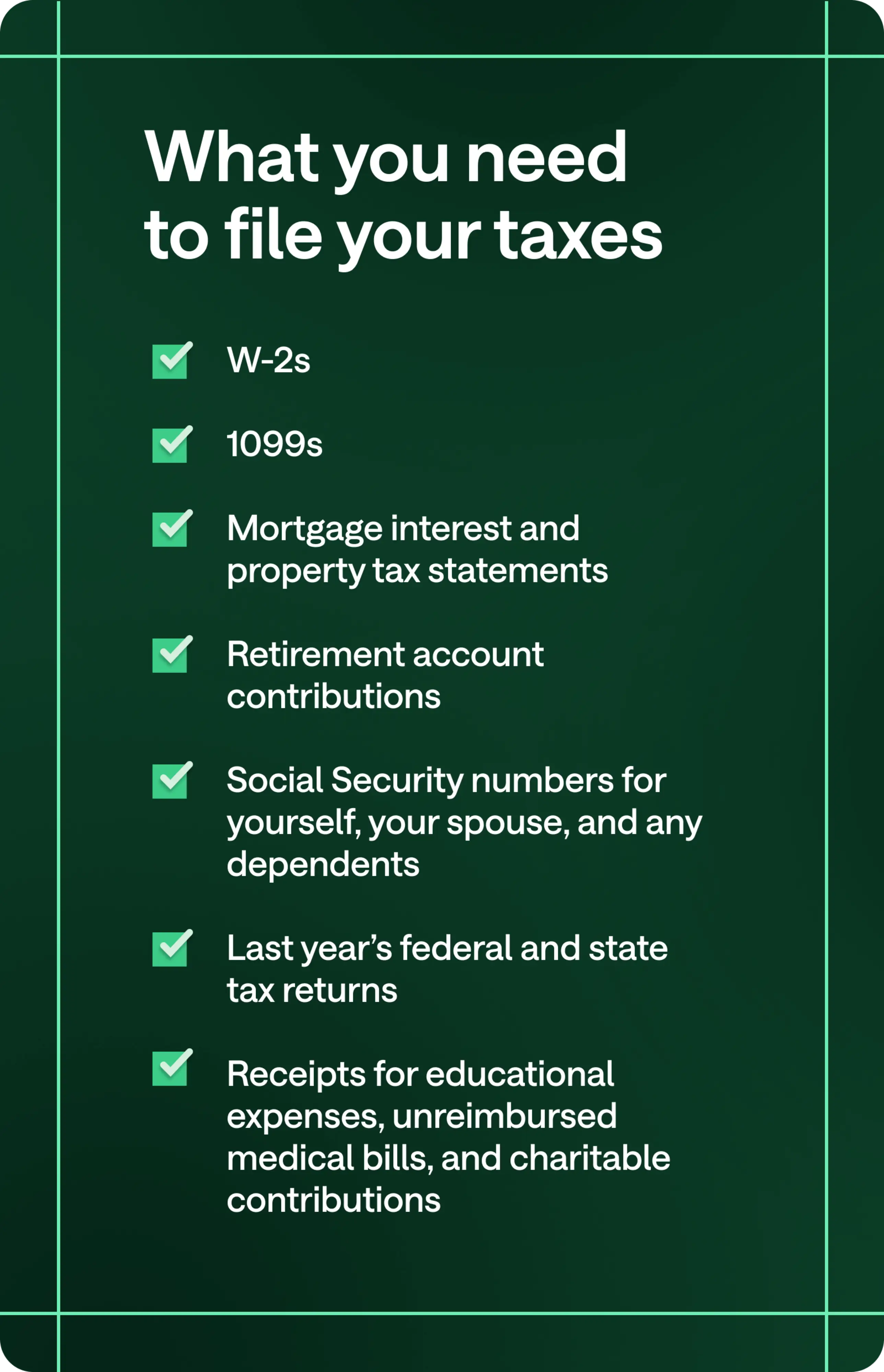
There are several tax documents you'll need to fill out to file your taxes. While the exact documents and forms required can vary depending on your situation, you'll generally need at least the following:
W-2s for any job you worked as an employee.
1099s for other income, like money earned as an independent contractor, interest from a bank account, or capital gains from a house sale.
Mortgage interest and property tax statements.
Retirement account contributions.
Social Security numbers for yourself, your spouse, and any dependents.
Last year's federal and state tax returns.
Receipts for educational expenses, unreimbursed medical bills, and charitable contributions, if applicable.
Write down 2026 tax dates
When filing your 2025 taxes in 2026, pay attention to two key dates: Jan. 31, 2026 (see disclosure 2) (the due date for your employer to send your tax forms) and April 15, 2026 (the filing deadline). (see disclosure 1)
January 31, 2026 | The due date for employers to send out W-2 forms and for certain 1099 forms to be sent to you (like if you're an independent contractor or are self-employed). |
|---|---|
April 15, 2026 | The deadline for filing 2025 taxes for individuals. |
April 15, 2026 | The deadline for individuals to request a tax extension. |
June 16, 2026 | The deadline for filing 2025 taxes for U.S. citizens or residents living abroad. (see disclosure 1) |
Choose between standard and itemized deductions
Take time to understand how tax deductions work since they impact your taxable income. When you file your taxes, you'll have two options: Take the standard deduction or itemize your deductions.
Standard deduction: If you have a 9-to-5 job and receive a W-2, you may be able to take the standard deduction. For 2025 taxes, the standard deduction is $15,000 for individuals and $30,000 for married people filing jointly. (see disclosure 3)
Itemized deductions: If itemizing all the deductions you qualify for allows you to deduct above $15,600 (filing single) or $30,000 (filing jointly), consider itemizing your deductions. Most tax preparation software and accountants can make a recommendation based on all of the information you share when preparing your taxes.
In general, you might want to consider itemizing deductions if you own property, run a small business, have major out-of-pocket medical expenses, or made considerable contributions to charity in 2025.
Chime tip: If you are married, both you and your spouse will need to take either the standard deduction or itemize deductions, even if you choose married, filing separately. (see disclosure 4)
File early and sign up for direct deposit
The sooner you file your taxes, the sooner you'll get your refund, if one is owed – which could mean more money in your savings account. If you want your refund as soon as possible, set up direct deposit – it's a safe and easy way to get your funds.
When filing electronically, you can set up direct deposit with the IRS to have your tax refund deposited directly to your account.
Tax return online vs. traditional methods
In the past, filing taxes involved filling out forms by hand and mailing your return to the IRS. However, the internet makes filing much quicker and more accessible, and you may find it a more convenient option. E-filing also eliminates the risk that your tax return will get lost in the mail since the forms are delivered electronically to the IRS.
Filing online is a more sustainable option since you won't need to use paper or mailing envelopes. It also reduces the need for physical storage systems to organize paper tax documents.
Filing your taxes online may cost you money if you file through a tax preparer or use tax software, making paper filing more attractive for some.
Chime members will be able to file their taxes for free through the Chime app – there's no fee for state or federal tax return filing.
Free Online Tax Filing: File 100% for free, max out your tax refund guaranteed (see disclosure 5) , and get your federal tax refund up to 5 days early (see disclosure 6) when you direct deposit it with Chime.
Common tax mistakes to avoid
Several common tax mistakes can lead to issues with your tax return. You can avoid most of them by slowing down and double-checking your inputs as you go.
Forgetting to sign and date
One common error is forgetting to sign and date your tax return. Without a valid signature, your return may not be considered filed.
To avoid this mistake, double-check that you've signed and dated where required before submitting your return.
Incorrect information
When you file your tax return, your name must be spelled the same way it's spelled on your Social Security card.
Your Social Security number must be entered correctly, as must information on your wages and other income received. If any of the information on your return is inaccurate, you may face delays and other issues.
Missing deductions and credits
Another frequent mistake is missing out on eligible deductions and credits that could reduce your tax liability. To avoid this, review the IRS's tax deductions and credits list.
Keep records of your expenses, and consider consulting a tax professional who can identify all potential deductions and credits that apply to your situation.
Missing write-offs
If you itemize your deductions, make sure you include all write-offs that you're eligible for. Missing write-offs can lead to paying more taxes to the IRS than you need to.
Faulty math
If you don't calculate your tax liability correctly, you may owe the IRS more than you pay. This, in turn, can lead to penalties if you don't realize your mistake until after the filing deadline.
Before submitting, double- and triple-check your math.
Selecting the wrong filing status
Selecting the wrong filing status can affect your tax liability. To avoid this mistake, review the IRS guidelines on filing status and choose the one that best matches your circumstances.
Filing late
Filing your taxes late can result in penalties and interest charges. Note the tax filing deadline and ensure you file your return on time. If you need more time, consider requesting an extension. Just remember that this extends the time you have to file, not the amount of time you have to pay any taxes owed.
Not reporting all income
Failing to report all your sources of income is a significant error that can lead to IRS inquiries or a tax audit. Make sure you keep accurate records of all income sources. This includes income earned from freelance or gig work, investments, and bank accounts that earn interest (like a high-yield savings account).
When you're ready to file, double-check that you've included all income on your tax return before submitting it.
File your taxes through Chime
You can file your federal and state taxes through the Chime app completely free. Direct deposit your federal tax refund with Chime and you can receive your refund up to five days early. (see disclosure 5) Maximum refund is guaranteed, (see disclosure 6) so you won't need to worry about settling for less than what you are owed.
Learn the definitions of 25 tax terms to demystify the tax-filing process.