
Key takeaways
You can transfer money between banks using online ACH transfers, wire transfers, paper checks, or payment apps like Zelle and Venmo.
ACH transfers are usually free but can take one to three business days, while wire transfers cost $20 or more but are completed in hours.
Consider speed, cost, transfer limits, and security when choosing your transfer method.
Need to move money between your bank accounts or send it to a friend? You've got several options, from free online transfers to same-day wire services. We'll walk you through each method so you can pick the best one for your situation.
Ways to transfer money between banks
There are four main methods to transfer money between banks. ACH transfers, wire transfers, traditional paper checks, or payment apps like Zelle and Venmo. Learn more about each below.
1. Bank-to-bank (ACH) transfers
Most standard online transfers use the Automated Clearing House (ACH) network. ACH payments are reliable and usually free, making them the most common way to move funds.
Although ACH transfers can take one to three business days to clear, about 80% clear within one business day, according to the National Automated Clearing House Association (Nacha).
2. Wire transfers
If you need to send a large amount of money fast, a wire transfer may be your best bet. It's like a direct line between banks and can often be completed within hours on the same business day.
The trade-off is the cost. Banks typically charge fees for sending and, sometimes, receiving wire transfers. Expect to pay $20 to $35 for domestic transfers and up to $35 to $50 for international transfers.
3. Paper checks
It might feel a bit old-school, but writing a check is still a perfectly good way to move money. You can write a check to yourself from one bank account and deposit it into your other account.
Many banking apps let you make a mobile deposit with your phone's camera, which saves you a trip to the bank. Checks typically take two business days to clear.
4. Payment apps and services
Peer-to-peer (P2P) apps like Zelle, Venmo, and Cash App are becoming increasingly popular for sending money. These services link directly to your bank account and let you send funds using just an email or phone number.
While convenient for personal transfers, be cautious – P2P scams are on the rise, and transfers are often instant and difficult to reverse. Only send money to people you know and trust.
Method | Speed | Cost | Best for |
ACH transfer | 1–3 business days | Usually free | Regular transfers between your own accounts |
Wire transfer | Same day (hours) | $20–$50 | Large, urgent transfers |
Paper check | 2 business days | Free | Traditional transfers without online access |
Payment apps | Instant | Usually free | Person-to-person payments |
How to transfer money between banks online
If you're moving money between two accounts that you own at different banks, an online transfer is usually the simplest way to go. Here's how sending money online generally works:
Log in to your bank's website or app from the account you're sending money from.
Find the transfers section – look for "Transfers," "External Transfers," or "Move Money."
Add your other bank account using the routing and account numbers.
Verify the account by confirming the small micro-deposits your bank sends. This verification step usually takes one to two days.
Enter transfer details – select accounts, amount, and date, then confirm.
Setting up recurring transfers
For regular payments, such as rent or automatic savings, you can set up recurring transfers. Look for a "recurring" or "frequency" option when entering transfer details.
Most banks let you choose weekly, bi-weekly, or monthly schedules, so you don't have to log in each time.
What to consider when transferring money
Not sure which method to pick? Here are the key factors to consider:
Speed: Wire transfers arrive in hours, ACH transfers take one to three days, and checks take about two days to clear.
Cost: ACH transfers are usually free, while wire transfers can cost $20 to $50.
Transfer limits: Most banks set daily or monthly limits that vary by transfer type – check these before sending large amounts.
Security: Double-check all account details before confirming, especially for wire transfers, which can't be reversed.
Why people are choosing Chime
J.D. Power data shows that customers are overwhelmingly choosing Chime over other financial institutions. Among all providers, Chime captured the largest share at 13%, beating out Chase at 9% and both Wells Fargo and Bank of America at 7%.
These numbers signal a shift in how people choose where their everyday money lives. Consumers are increasingly choosing digital-first, app-based financial services to manage their primary spending and deposits through digital banking channels.
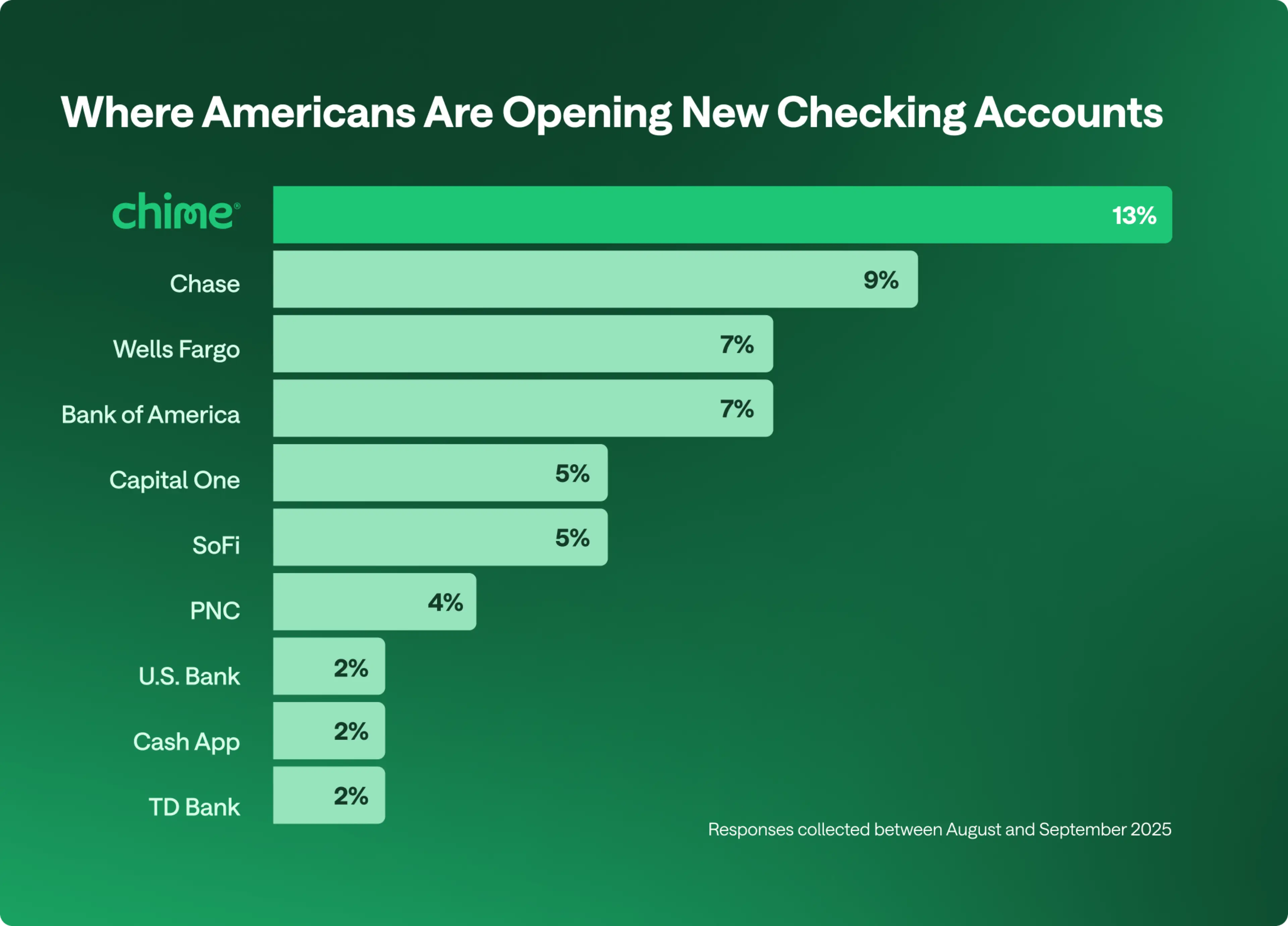
Source: J.D. Power Financial Services Churn Data and Analytics
Start moving your money with confidence
Now that you know the four main ways to transfer money between banks, you can choose the right one for your needs. Pick the method that matches your timeline and budget, then follow the steps to get your money where it needs to go.
Ready to switch banks entirely? Learn how to switch banks for a smooth transition.